Showing posts with label Overnight Technique. Show all posts

Wednesday, 20 February 2008

Sticky, sticky goodness

I'm getting a bit lame at posting things as soon as I do them and this one has taken almost a week to reach the online community. Apologies, I shall try and get my work/personal life priorities realigned.

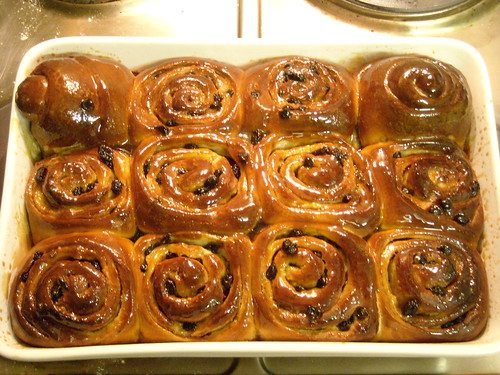
So this was last weds/thurs creation (the overnight technique strikes again) and is a well known English favourite, Chelsea Buns. For those of you who haven't had the pleasure of sampling their delights it is basically a sweet yeasted bread containing currants and spices and covered all over with a sticky sugar glaze; it should look something like this:

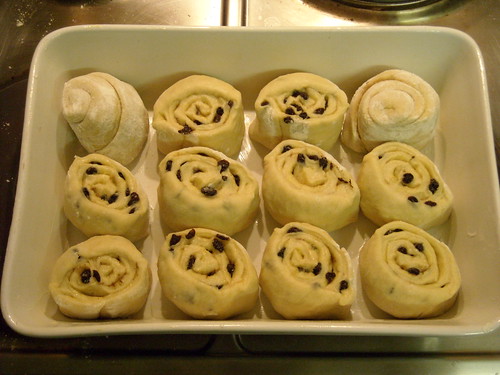
During the preparation it is important to space them apart enough to allow for rising, but not so far that they don't join together when they have risen sufficiently. There are some extra pics below to illustrate this. The glaze is also a very important element to this recipe, although they taste good without it (and might be better for those watching their waistlines), they are a little dry and the glaze really makes them sweet and special. Make it using two tablespoons of Golden Syrup to one large teaspoon treacle (molasses to our American cousins), and heat that in a mug in a microwave or pan on the hob to make it nice and runny so it mixes together and brushes over the hot buns easily.
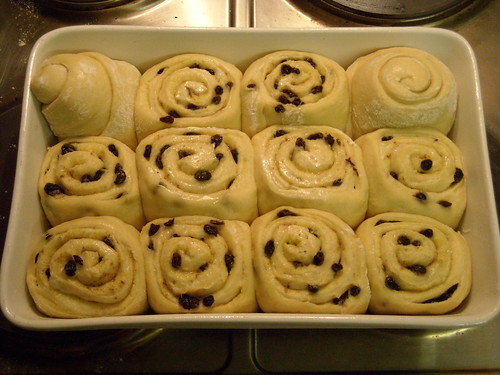

This recipe makes twelve buns, which is a bit much for just two people as they don't keep particularly well, so either decrease the measures and the dish they go in or, as I did, take the rest to work and be your colleagues' favourite person for a day.

Stick that in your lunch box and munch it.

Friday, 18 January 2008

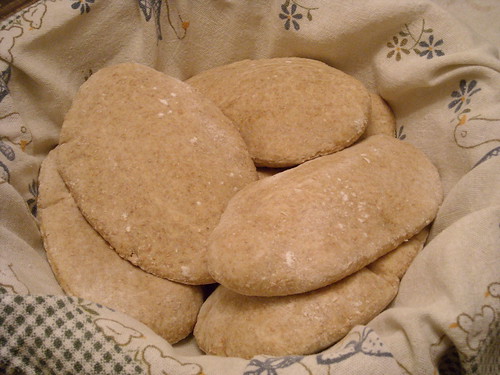
Pitta Bread

If you thought that the previous recipe was easy then this one is going to be simple for you. Pitta bread is a popular staple in sandwiches and snacks, but the shop bought varieties are a poor reflection of home-baked pitta, made more to last than for their taste or texture.

This pitta bread recipe is probably Greek in origin as many flat breads such as these are made without yeast in north African countries and the Middle East. As usual I have slightly adapted the recipe to also be suitable for overnight baking, but by now seasoned readers should be getting the hang of slowing the rising to make bread baking fit your schedule; after all we're much more intelligent than the yeast. I prefer to make mine using the half and half wholemeal/white method, but they are just as good when made with only strong white flour (I shall write a post about flour types in the near future).

The main point to note when making this bread is that it is really important to have the oven and the trays hot before baking. In order to get the breads to split properly and puff up during cooking they need a sudden and extreme rise in temperature to create steam pressure within the bread (watching them as they bake is quite entertaining).

Once made the breads can be used to make delicious sandwiches, and any leftovers can be toasted and cut into strips for dipping in old favourites such as hummus or guacamole.

Be better bread.

Saturday, 8 December 2007

Another Natural Leaven

Over the last couple of days I have been following another method of making and using a natural leaven. This process comes from French bakers and is known there as a chef, but the principle is much the same as that described earlier. The main difference in this method is that the entire leaven is used to make the dough and then a small amount of the dough is saved before baking to start the next one. The advantage of this method is that, if you are not baking every day, the leaven will store well in the fridge without attention; you only refresh it when you make a new dough. I have seen examples of this method where it is instucted not to leave it more than three days, but I have successfully restarted it after up to three weeks (if you are going to do this make sure it is in a clean, sealed container and that the resulting bread is cooked at high temperature for a relatively long time).

As this is a natural leaven it is slow to get going and very varaiable from place to place, so you may have to adapt the recipe yourself to suit the culture, but the results I get here are a deliciously tangy bread (the taste develops over successive use) with a very firm crust. To encourage the formation of this crust I often increase the humidity of the oven by putting a heat-proof dish with a small amount of water in the bottom both before and during baking. This recipe also benefits from being one that can be left for its second rise, or proving, out of the fridge overnight, so it is ready to just pop in the oven in the morning and doesn't take up fridge space.

I hope you experience similar results to myself, this recipe (or rather its product) has been appreciated by all who have tried it, including the French friend I was helping to move house today, so give it a go.

Be busy baking.

PS In case anyone is keeping track of my baking schedule; I posted on Thursday, baked the above bread on Friday morning, pizza for five on Friday evening (2 Englishmen, 3 Italians), and the above bread again this morning as well as Ciabatta which, as I'm sure you all well know, follows pizza every time.

Wednesday, 28 November 2007

Focaccia

Even though I haven't baked this today I have started it already, so I feel justified in posting this, my signature recipe. Originally an Italian bread made while the ovens were heating up (it is cooked cooler than most Italian breads), it has acheived worldwide renown. I have made a few adaptations over time, not least of which is the overnight technique. This really is one of the easiest (and tastiest) overnight breads I have adapted, especially if your oven has a timer function; I time mine to be hot when I get up and then just take the breads out of the fridge, chuck some olive oil on top and pop them in the oven while I get ready. It can take a while to cool down, but if you really do leave it to the last minute in the mornings it can be wrapped in paper warm, taken to work and even eaten on its own it is so flavoured.

The recipe is detailed enough that it shouldn't cause many people problems (still some updating to do, but I don't think anyone will be downloading it before I get a chance). I will say that it requires quite a bit of kneading to acheive a smooth dough, because it is quite a dry mix, but as this is all done the night before in most cases I don't find it too tiring.

It is possible, and maybe more traditional, just to roll out the dough and put it onto baking trays as a sort of rough circle, but I have found it makes a better bread and is less prone to crust problems if it is enclosed in a tin. Sandwich tins (as in the recipe) are the tins usually used for making sponge cakes and the ones with a removable base are best as they save you having to tip an oil covered loaf upside down. The sides encourage it to rise by containing the dough, making for a softer and looser crumb.

I'll get to troubleshooting sometime soon, when I shall go into more detail about 'crust problems', so if you have any questions leave them in the comments and I shall hopefully be able to answer them.

Till next time.

Wednesday, 21 November 2007

A Simple Bread

Today I made my standard bread by the overnight recipe. This probably means nothing to you, so I think I shall have to do some explaining first; the only problem is where to start.

The most basic breads are a simple combination of flour, salt, liquid (usually water) and a raising agent (usually yeast). Yeasted, or leavened, breads are made in stages. First all the ingredients are mixed together and the mixture is worked by stretching and folding. This strengthens the dough by getting the proteins in the flour to form strings; an easily visible effect when kneading fresh dough. The dough is then left to rise for a period of time, 'knocked back' by a second kneading process and left to rise again after being formed into the desired shape. After this baking fixes the dough and kills the yeast, and the bread is ready to be eaten.

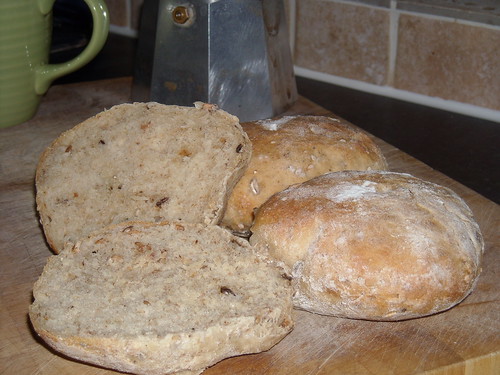
This simple bread mix requires very little kneading and can be used to make almost any shape of loaf or roll required. I like to make mine as a granary dough, but it works equally well with other types of flour (no doubt we will get to that in later posts).

The overnight technique I have developed works by leaving the dough in the refrigerator overnight to slow the initial rising period and then forming the bread into rolls for a quick baking and cooling time. This means I can get up, form the bread into rolls, leave it to rise while I am having a shower, bake it in ten minutes and it is cool and ready for making sandwiches by the time I've finished my breakfast.

In order to save space in this blog (definately needed with posts like this one!) recipes will be available as downloadable .pdfs. This has the added advantage of not getting flour on your computer! So to start us off the basic recipe for rolls (baps to give them their original Scottish name) is here and then there is the slightly adapted overnight method.

I think that will do for this enormous post, I shall be back soon to talk about how this versatile recipe can be adapted to provide delicious bread for almost any occasion, and there will of course be some more advanced breads, cakes and puddings in the future. I hope you will keep popping back and I wish you much happy baking.